
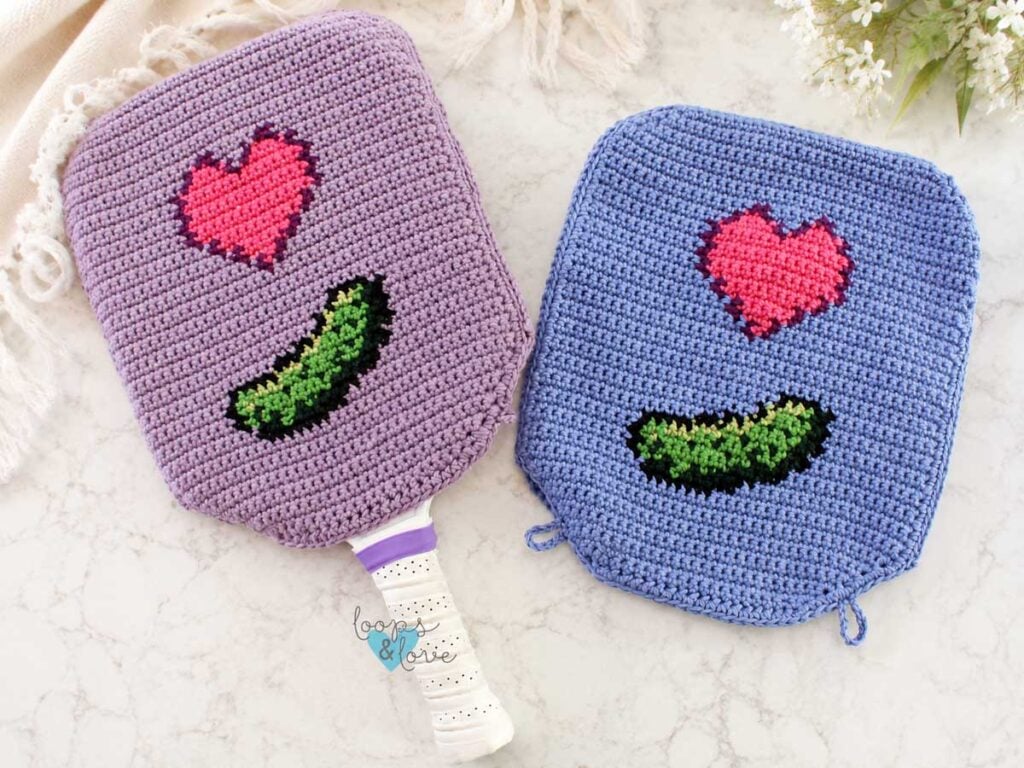
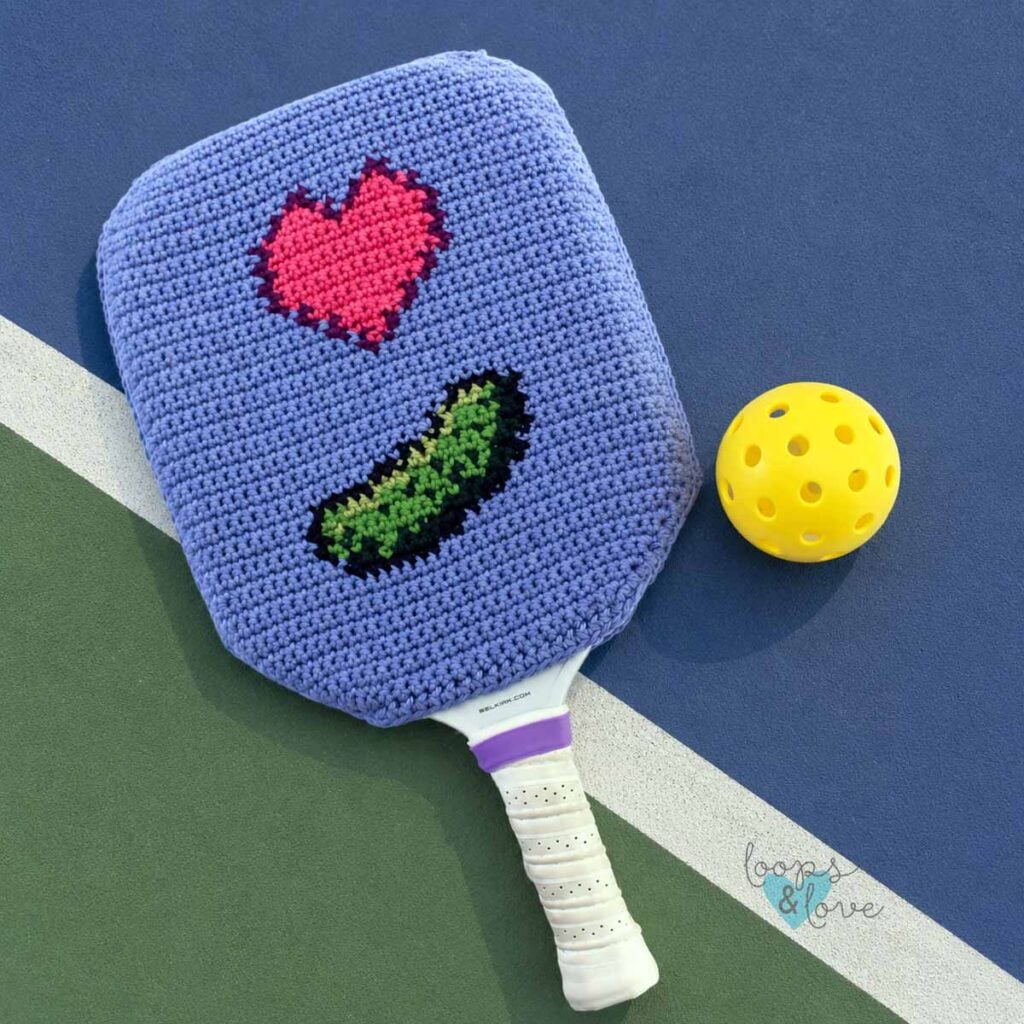
Keep your paddle protected in style with this crochet Pickleball Paddle Cover! Featuring a fun pickle and heart design, this cover is perfect for pickleball lovers who want to add a little personality to their gear. Whether you’re making one for yourself or as a thoughtful gift for your favorite pickleball partner, this paddle cover adds a handmade touch while helping protect your paddle from scratches or scuffs when it’s traveling in your bag to and from the court!
Pickleball Meets Crochet
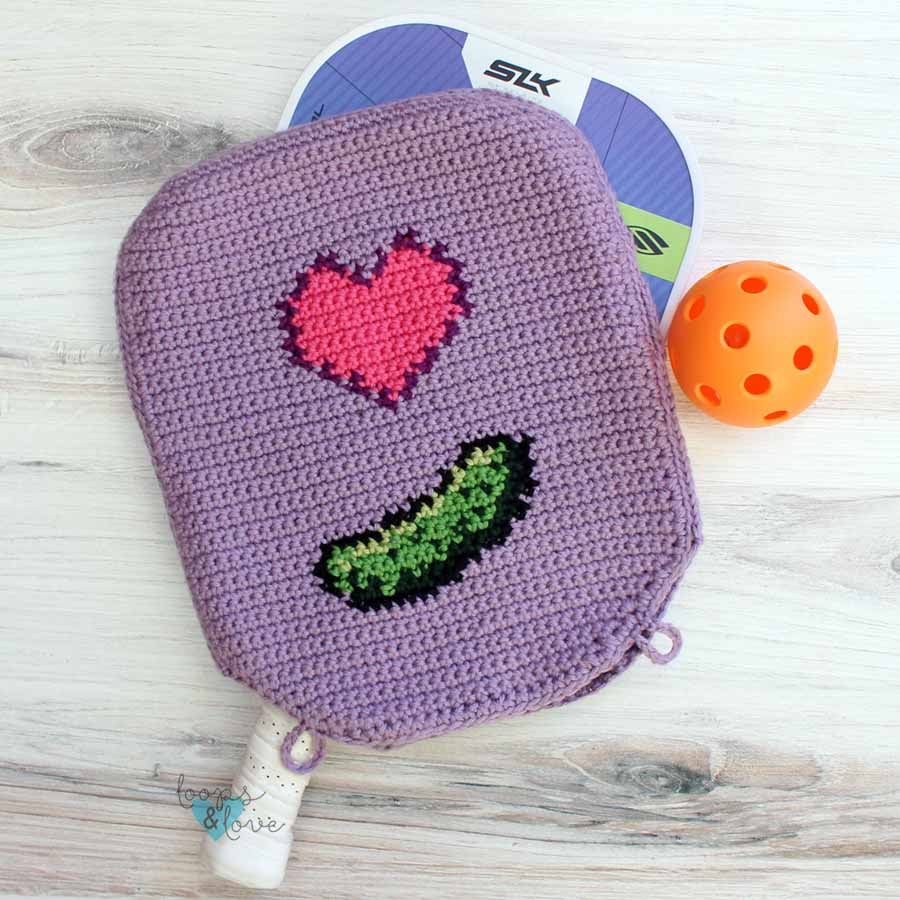
Do you play pickleball? A friend and I started playing a few months ago, and we’ve been obsessed since! We upgraded our paddles and I thought, what would be better than a custom-made paddle cover to keep it safe?! I love colorwork, so I drew up a cute graph right away and got started. Of course I also had to make one for my favorite pickleball partner! I even did surface slipstitches on the back to put our names on them!
Remember to like Loops and Love Crochet on Facebook and join the Loops and Love Crochet Group for sharing your finished projects! I’d also LOVE it if you followed @loopsandlovecrochet on Instagram! If you like crochet video tutorials, check out (and subscribe to) my Loops and Love Crochet YouTube Channel!
A Fun Crochet Accessory for Pickleball Lovers
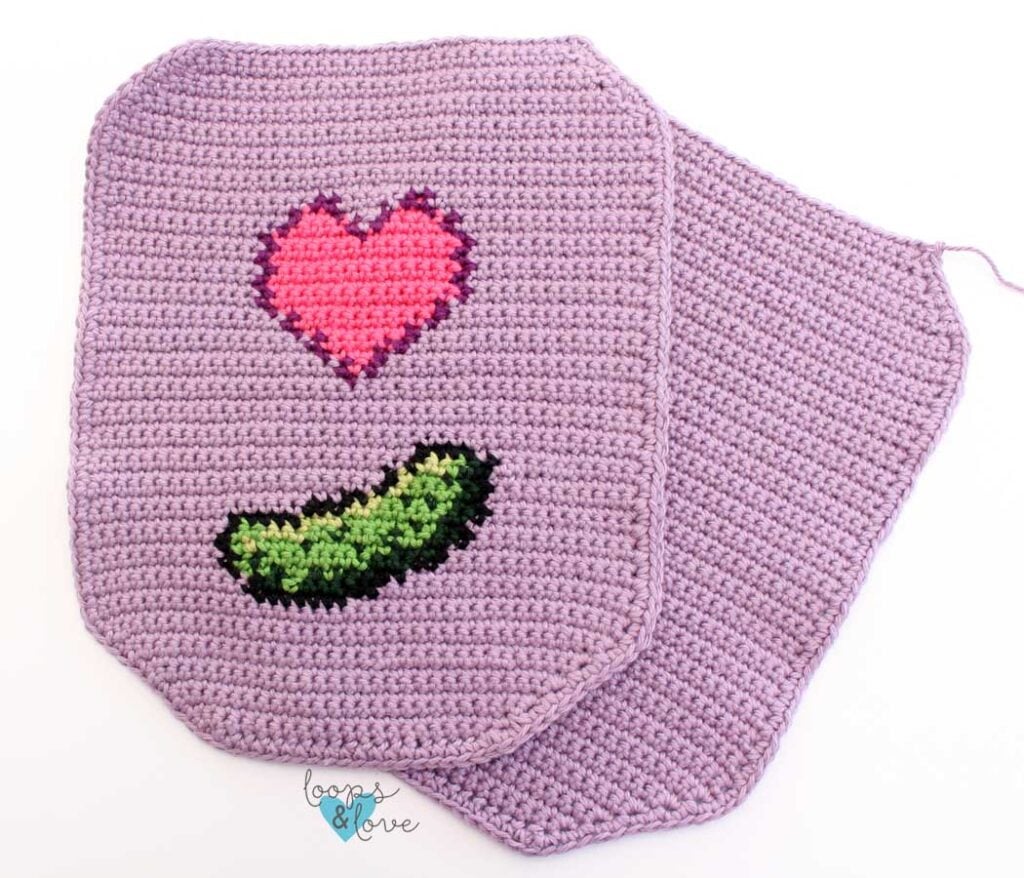
This Pickleball Paddle Cover is made using intarsia crochet techniques (explained in more detail later in the pattern) to create the colorwork design. The cover is worked as two separate panels that are crochet together to form a pocket that fits a standard pickleball paddle. Button closures are added at the bottom edges to help keep your paddle securely tucked inside when not in use.
This pattern is a great introduction to crochet colorwork and includes step-by-step instructions to guide you through the process. Whether you’re new to tapestry and intarsia crochet or have experience with colorwork projects, you’ll enjoy watching the design come to life as you stitch. The finished cover is both practical and fun—a perfect accessory for trips to the court, league nights, tournaments, or casual games with friends.
I hope you enjoy making your Pickleball Paddle Cover as much as I enjoyed designing it. Happy crocheting and happy pickleballing!
Not ready to make this pattern now? Pin it to your favorite Pinterest boards to save for later!
If you’re looking for more tapestry/intarsia crochet designs on the blog, be sure to check out the Northern Lights Wall Hanging, Bee Happy Wall Hanging, Spring Wall Hanging, Fall Wall Hanging, Butterfly Pillow, Kindness Wall Hanging, and some tapestry crochet bags too!
Disclosure: This post may contain affiliate links, which means I may receive a small commission if you click a link and purchase something that I have recommended. This is done at no extra cost to you. Thank you for supporting Loops & Love Crochet!
This Crochet Pickleball Paddle Cover crochet pattern is available for FREE on this website. If you’d like an ad-free, printable PDF version, you may purchase it for a small fee from my Etsy or Ravelry shops. Thank you so much for supporting Loops & Love Crochet!
Materials
- Worsted weight #4 yarn – The pickleball paddle cover pictured in this pattern was made with WeCrochet/Knit Picks Comfy yarn which is 75% cotton and 25% acrylic. Either cotton or acrylic yarn (or a blend) can be used for this project. This yarn is a little on the thinner side for a worsted-weight yarn. If you are substituting with another yarn, please refer to the gauge as your project may turn out larger or smaller, depending on yarn thickness. A total of approximately 220 yds will be needed for this project. The colorways and yardages used are 115 yds in the main background color (Background colors of Hydrangea and Lilac are pictured in this pattern), 20 yds of Honeydew (light green), 25 yds of Peapod (medium green), 5 yds of Ivy (dark green), 5 yds of Black, 30 yds of Zinnia (pink), and 5 yds of Lilac (dark purple).
- Crochet hook – 4 mm size crochet hook
- Buttons – two buttons are needed. The buttons on the paddle cover pictured are about 1.5 cm in diameter. A larger button could be used, but smaller might not hold the button loop closed.
- Needle and thread – for sewing on the buttons.
- Yarn needle for weaving in ends.
- Scissors for cutting ends. (I love these little scissors!)
Stitches Used
- Ch – Chain
- Sl St – Slip stitch
- SC – Single crochet
Gauge
- 2” square = approximately 11 rows of 9 SC stitches.
Finished Size
- When finished and laying flat, this pickleball paddle cover measures approximately 9” wide x 10.5” tall. This paddle cover is designed to fit over the face of a standard sized pickleball paddle that measures up to 16” in length (top of paddle to bottom of handle) and up to 8” in width and 16mm in thickness.
Important Notes
- Turned Rows– Each panel is worked in turned rows of SC stitches. At the end of each row, chain 1 and turn. Chain 1 stitches do not count towards stitch count.
- Color Changes – You will be changing colors often in this pattern. To change colors, complete the last SC in the first color up until the last yarn over. Yarn over with the new color and pull through last step of the SC stitch.
- Intarsia Crochet Tips – For this project, you will be using the intarsia crochet technique. When you change colors, you will not be carrying the unused colors along under your stitches. Instead, you will be dropping the color that you are finished with (leaving it attached) and picking up the next color, pulling it over to where you are working the stitches. Separate bobbins of the same color will be needed to prevent long floats of yarn carried. There will be a right side (RS) and wrong side (WS) of this project. A further explanation on this is in the Graph Instructions below.
- Video Tutorial – There is not a specific video tutorial for this pattern, however, to see how an intarsia crochet panel is worked up from another pattern, please see the video tutorial on my YouTube Channel HERE. This video provides more explanation and visuals on how to read a graph, work color changes and pick up and drop yarn.
Graph Instructions
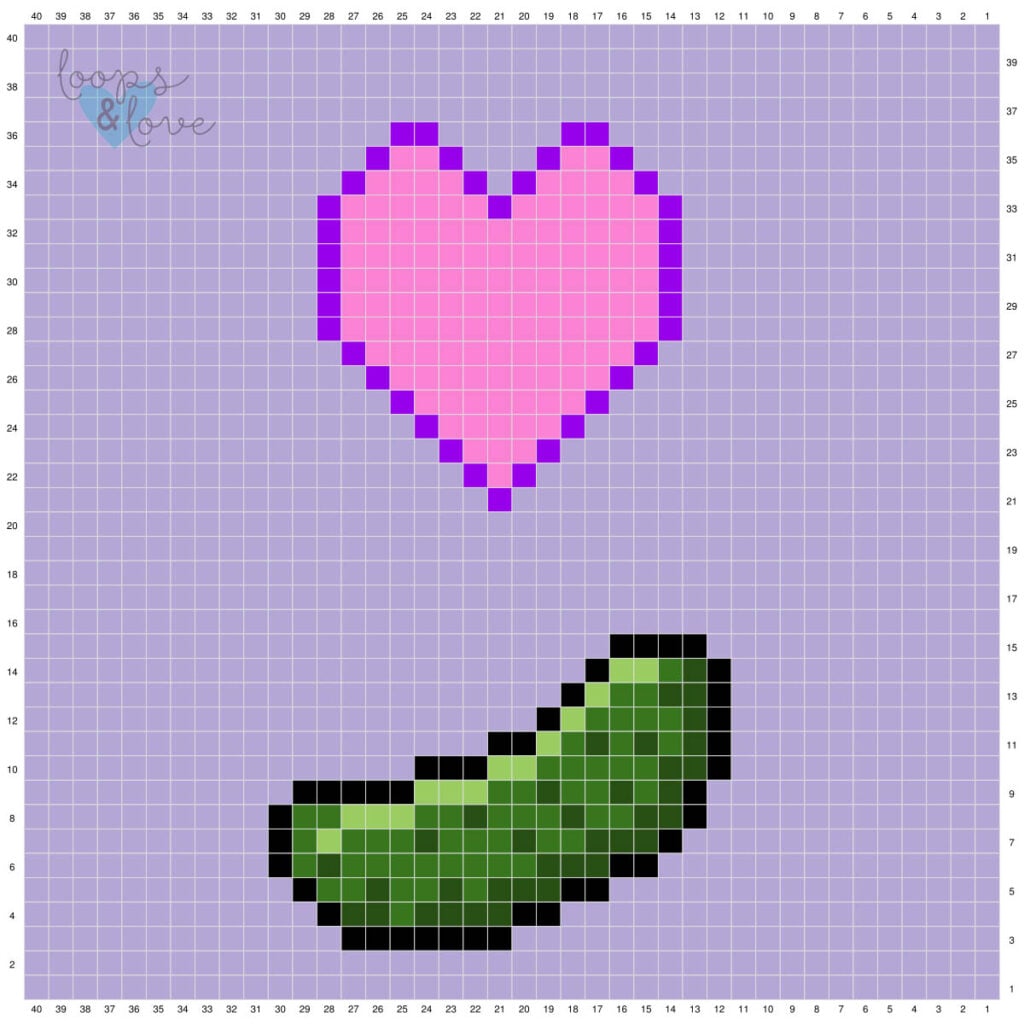
Below, you will see the graph for this project. Each box in the graph counts as one SC stitch.
To read this graph, you will be starting at the bottom right (or left if you’re left-handed) and working your way across in back-and-forth rows. All ODD numbered rows will have the right side of the project facing you, EVEN numbered rows will have the wrong side facing you. When you are working on the right side (RS), make sure you are dropping the yarn to the back (away from you) for the color changes. When you are working on the wrong side (WS), make sure you are dropping the yarn on the front (towards you) for the color changes. This will ensure that the front of the paddle cover does not show any of the color changes since all the yarn is dropped the back (wrong side).
On the wrong side, you will start to see where you drop and pick up each color. This will be inside of the case when the two panels are crocheted together and will not be seen. To help keep your yarn floats across the back of your project shorter, it is helpful to use two bobbins (or separate skeins) of some colors in a few places, when the sections of the same color more than a few stitches apart. This is helpful because where you drop the yarn for a color change will be very close to where you pick it back up in the same place on the next row when changing back to that color.
When working up this project, I used two bobbins in the following places:
- Background color (one for each side of the pickle and again for the heart).
- Black (one for each side of the pickle)
- Purple (one for each side of the heart)
As an alternative to using bobbins, you can also carry your yarn under your stitches at times when the colors are further apart to reduce the length of the floated yarn on the back. If you are carrying yarn, be sure to keep it towards the back of the project and bottom of the stitches so the carried color will show through less between your stitches when looking at the front of your project.
Remember to keep consistent tension, even when working all the color changes. This is so your panel comes out nice and even on the sides. However, if it is a little off at the end, blocking it will even it out.
The Pattern – Let’s Get Started!
Start by working up two panels, one with the colorwork design and one without. Panels are worked from bottom to top.
For working this pattern, the colors are as follows:
A – Lilac (or your chosen background color), B – Black, C – Dark Green, D – Medium Green, E – Light Green, F – Purple, G – Pink
Row 1: In color A, ch 21, SC in 2nd ch from hook and in each st across, ch 1, turn (20)
Row 2: INC in first st, SC in each st across, INC in last st, ch 1, turn (22)
Row 3: INC in first st, SC in each st across, INC in last st, ch 1, turn (24)
Row 4: INC in first st, SC in each st across, INC in last st, ch 1, turn (26)
Row 5: INC in first st, SC in each st across, INC in last st, ch 1, turn (28)
Row 6: INC in first st, SC in each st across, INC in last st, ch 1, turn (30)
Row 7: INC in first st, SC in each st across, INC in last st, ch 1, turn (32)
Row 8: INC in first st, SC in each st across, INC in last st, ch 1, turn (34)
Row 9: INC in first st, SC in each st across, INC in last st, ch 1, turn (36)
Row 10: INC in first st, SC in each st across, INC in last st, ch 1, turn (38)
Row 11: INC in first st, SC in each st across, INC in last st, ch 1, turn (40)
Now we have increased to the full width of the paddle cover (however, it will be a bit wider later when working SC stitches around and joining to the second panel). For the next rounds, the design will be worked following the graph for the color changes (or written instructions below). The row count will start at 1 again so the row counts match the row on the graph.
Rows 1-40: SC in each st across. Follow the graph for the color changes or the written instructions below. Chain 1 and turn after each row. (40) (Larger graph on last page)
← Row 1 [RS]: A40
→ Row 2 [WS]: A40
← Row 3 [RS]: A20, B7, A13
→ Row 4 [WS]: A12, B1, C2, D1, C4, B2, A18
← Row 5 [RS]: A16, B2, C3, D1, C1, D2, C1, D2, B1, A11
→ Row 6 [WS]: A10, B1, D1, C1, D8, C3, B2, A14
← Row 7 [RS]: A13, B1, C3, D2, C1, D3, C1, D3, E1, D1, B1, A10
→ Row 8 [WS]: A10, B1, D2, E3, D2, C1, D3, C1, D2, C2, B1, A12
← Row 9 [RS]: A12, B1, C1, D1, C1, D2, C1, D2, E3, B5, A11
→ Row 10 [WS]: A16, B3, E2, D5, C2, B1, A11
← Row 11 [RS]: A11, B1, C1, D1, C1, D1, C1, D1, E1, B2, A19
→ Row 12 [WS]: A21, B1, E1, D4, C1, B1, A11
← Row 13 [RS]: A11, B1, C2, D2, E1, B1, A22
→ Row 14 [WS]: A23, B1, E2, D1, C1, B1, A11
← Row 15 [RS]: A12, B4, A24
→ Row 16 [WS]: A40
← Row 17 [RS]: A40
→ Row 18 [WS]: A40
← Row 19 [RS]: A40
→ Row 20 [WS]: A40
← Row 21 [RS]: A20, F1, A19
→ Row 22 [WS]: A18, F1, G1, F1, A19
← Row 23 [RS]: A18, F1, G3, F1, A17
→ Row 24 [WS]: A16, F1, G5, F1, A17
← Row 25 [RS]: A16, F1, G7, F1, A15
→ Row 26 [WS]: A14, F1, G9, F1, A15
← Row 27 [RS]: A14, F1, G11, F1, A13
→ Row 28 [WS]: A12, F1, G13, F1, A13
← Row 29 [RS]: A13, F1, G13, F1, A12
→ Row 30 [WS]: A12, F1, G13, F1, A13
← Row 31 [RS]: A13, F1, G13, F1, A12
→ Row 32 [WS]: A12, F1, G13, F1, A13
← Row 33 [RS]: A13, F1, G6, F1, G6, F1, A12
→ Row 34 [WS]: A13, F1, G4, F1, A1, F1, G4, F1, A14
← Row 35 [RS]: A15, F1, G2, F1, A3, F1, G2, F1, A14
→ Row 36 [WS]: A15, F2, A5, F2, A16
← Row 37 [RS]: A40
→ Row 38 [WS]: A40
← Row 39 [RS]: A40
→ Row 40 [WS]: A40
The colorwork part is complete. Next, rows with decreases will be worked to taper the top of the paddle cover. Row count will continue. Keep working in the main color.
Row 41: SC DEC, SC next 36 sts, SC DEC, ch 1, turn (38)
Row 42: SC DEC, SC next 34 sts, SC DEC, ch 1, turn (36)
Row 43: SC DEC, SC next 32 sts, SC DEC, ch 1, turn (34)
Row 44: SC DEC, SC next 30 sts, SC DEC, ch 1, turn (32)
Row 45: SC DEC, SC next 28 sts, SC DEC, ch 1, turn (30)
Row 46: SC DEC, SC next 26 sts, SC DEC, ch 1, turn (28)
Row 47: SC in each st across (28)
Do not ch 1 or turn. Next, we will single crochet a border around the outside of the panel. Continue working one SC at the end of each row down the side, across the bottom, and then back up the other side. Join with a slip stitch to the top corner stitch (this is the top of the first SC stitch of row 47). Fasten off and weave in ends. Set first panel aside for now.
Follow the instructions above again to work up the second panel the exact same size as the first. This one is plain, so skip all the colorwork in rounds 1-40 and just continue working rows of SC stitches in the main color (unless you would like both sides of your paddle cover to have the heart and pickle design).
Joining the Panels Together
Now that both panels are worked up, it is time to attach them together. Place one panel on top of the other, with the “right sides” of the panels facing out. This means that the front of the heart and pickle panel should be facing up on the top and the front side of the plain panel (with the frontside of the SC stitch border) should be facing downwards. Attaching stitch markers or pins in a few places can help keep the panels lined up while joining them.
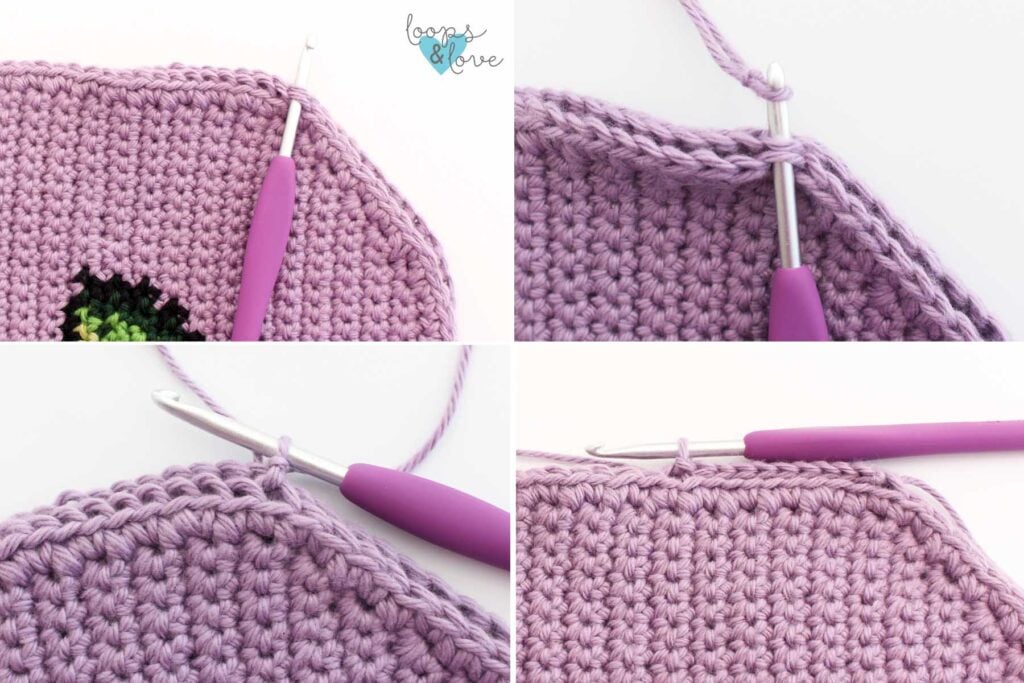
Make a slipknot with your yarn and join it to a stitch at the corner just after the diagonal created by the increases (this will be right around row 1 of the colorwork section). If you are right-handed, you should be joining on the right side of your project (and the left side if you are left-handed). When joining the yarn, pass it through both panels, but only through the two inner loops. This will be the back loop of the top panel and front loop of the bottom panel (see photos below). Chain 1, slip stitch in the same stitch. Continue working slip stitches in the same inner two loops of each stitch all the way around, joining the panels. Stop on the other side when you reach the diagonal part where it tapers towards the bottom. This should line up where you started working on the other side.
Fasten off, weave in all ends. Now that the panels are joined, you should have a pocket shape with a large open area at the bottom. Next, we will add button loop closures to close the bottom a bit more when the paddle is inserted into the case.
Adding Button Loop Closures
Now that the panels are joined, the final step is adding the buttons and loops to close the bottom more when your pickleball paddle is in the case.
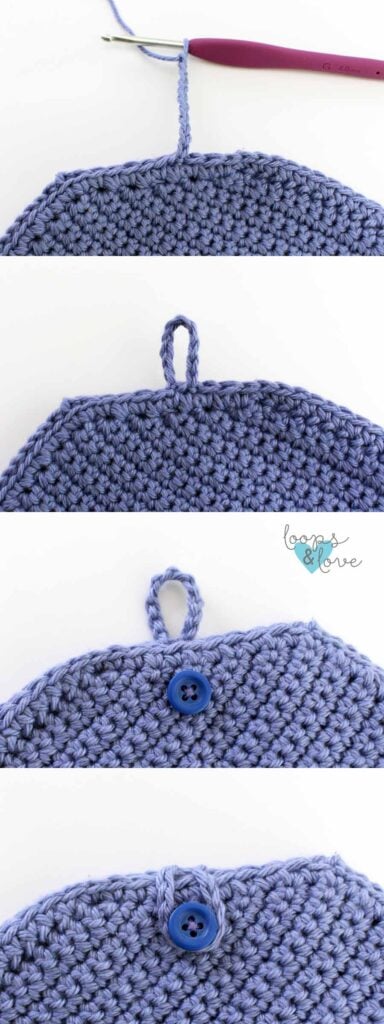
First, the button loops will be added. With the front side of the paddle cover facing you, find the center two stitches on one of the diagonal sides of the paddle cover. Join your yarn in the right center stitch (the left stitch if you are left-handed). Chain 10 stitches (with a little tighter tension) and then join with a slip stitch to the next stitch on the left. Fasten off and weave in ends. Repeat to add the button loop on the other side. (See photos below)
Next, flip the cover over so the back is facing you. Line up your button with the button loop closer and sew it in place approximately half an inch in from the edge. Before fully sewing the button in place, test the position by closing the loop over it. It is okay if it’s a bit loose right now because the paddle will take up space and make the closure tighter. Repeat to sew the button on the other side.
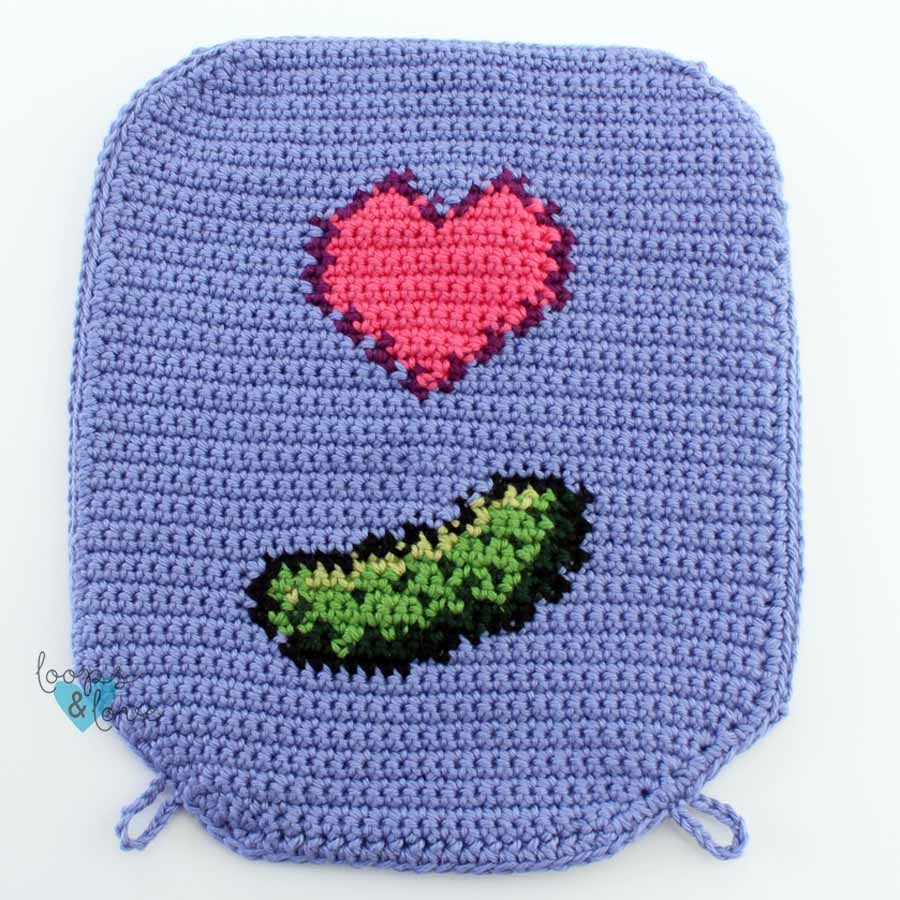
You are all finished your pickleball paddle cover! Now go ahead and insert your paddle. Warning – All your pickleball friends will be envious of your new paddle cover and may ask you to make ones for their paddles too!
I hope you enjoyed this crochet pattern! Please tag me @loopsandlovecrochet if you share on social media! Feel free to reach out to me if you had any questions as you were working up the pattern!
**Want to be kept in the loop? Be sure to like Loops and Love Crochet on Facebook and join the Loops and Love Crochet Group! Don’t forget to follow @loopsandlovecrochet on Instagram! Remember to tag Loops and Love Crochet when you post your fnished projects on social media! I’d love to see them! **
*You may make and sell any items made from my patterns, but please link back to my blog or Loops & Love Crochet as the designer. Please do not copy this pattern or photos and share as your own, in part or in whole. Instead, link back to the Loops and Love Crochet blog (especially when selling items you make from my patterns). Thank you!